About · how this works
Every story shows where it came from.
The Raytrace answers one question each day: what happened in video games? It reads companies' own announcements, other outlets' headlines and public records, finds who said it first, and writes the day's stories with AI, checked by code against the sources before anything runs (how we use AI). This page explains every label on the front page, then how the whole thing works.
How to read The Raytrace
The top of the front page, labeled. Tap a number to jump to its entry. Every "?" on the front page links here too.
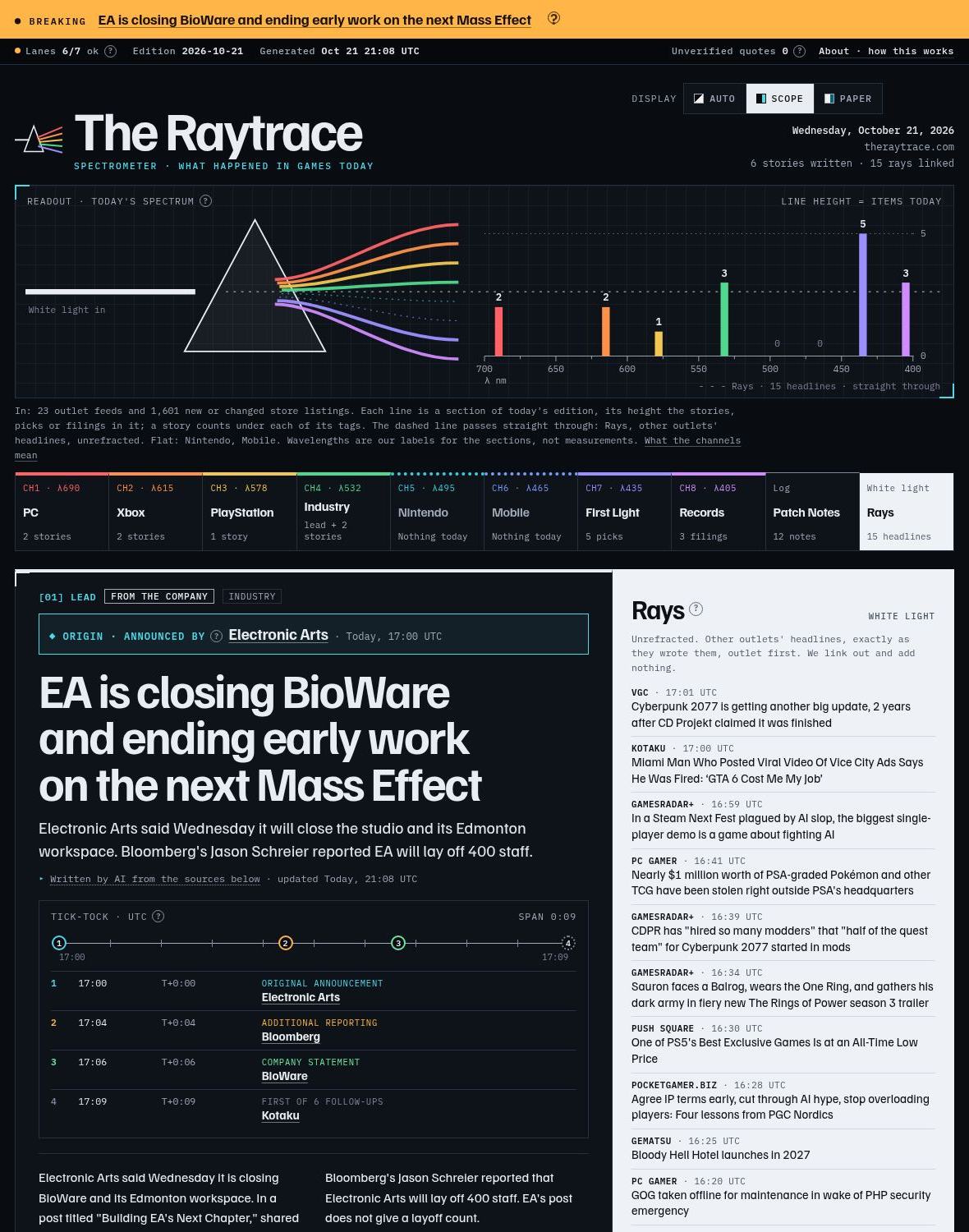
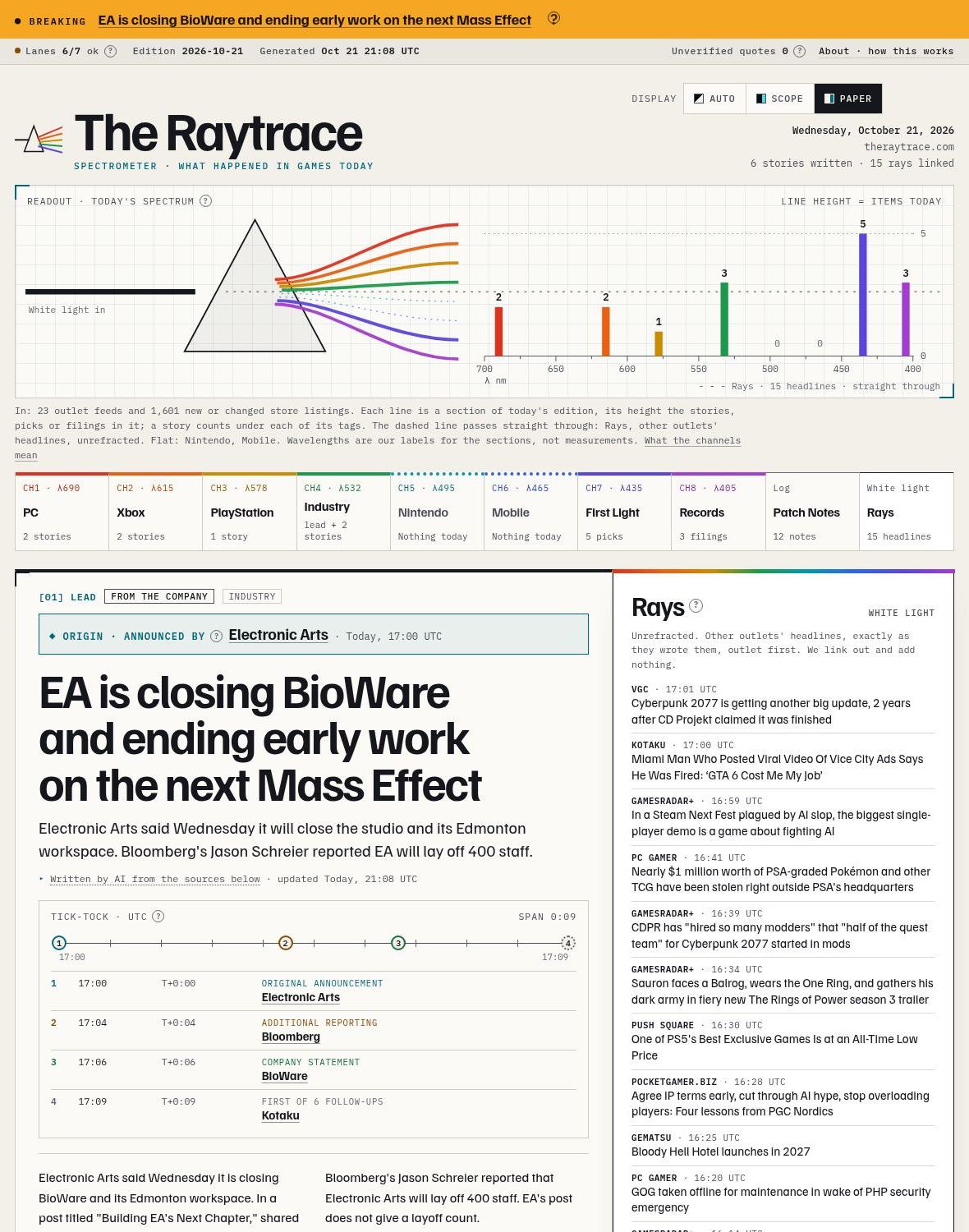
Breaking
A one-line banner across the very top, used rarely. It appears when four or more outlets pick up a story within 90 minutes of the first report, in the last six hours. The editor can switch it on or off by hand.
Lanes and Source status
Each kind of source we read is a lane: outlets' headlines, company newsrooms, Steam announcements, the business press, discovery, public records. The strip counts how many ran today; Source status, at the bottom of the page, lists each one. A lane that's down is shown, never hidden, and the section it feeds says so.
Unverified quotes Coming
A count of quotes anywhere in today's edition that couldn't be matched word for word to their source. It should always read 0, since a story whose quotes don't match never runs. It returns to the page once it's computed from each edition.
Display: Auto, Scope, Paper
Scope is the instrument's dark screen. Paper is the same readout printed on warm chart paper, with inks chosen for paper. Auto follows your device's light or dark setting. Your choice is remembered on this device.
The spectrum
White light comes in from the left, the prism splits it, and each colored line lands on a scale. A line's height is how many stories, picks or filings that section has today; a flat line means nothing today. A story counts once for each of its tags. The dashed line that passes straight through, unsplit, is the Rays.
The wavelengths (690 nm, 615 nm…) are our labels for the sections, not measurements.
Channels
One cell per section, in spectrum order: PC, Xbox, PlayStation, Industry, Nintendo, Mobile, First Light, Records, then Patch Notes and Rays. Tap one to jump there. A story wears the color of its first tag. The colors are ours, never a platform's brand color.
Rays white light
Other outlets' headlines, exactly as they wrote them, outlet first, each linking to their story. It's white light: we don't split, summarize or rewrite it. We read only the headline in each outlet's own feed and never fetch their articles. A headline that's already among a story's sources is left out.
Status labels
From the company: the news is the company's own announcement. Confirmed by: the company confirmed it after others reported it. Reported, not confirmed: so far it's only a report, and every claim is attributed to the outlet that made it.
Origin
Every story opens by saying where the news came from: who announced it, or who reported it first, linked, with the time. "Announced by" is a company's own post. "Reported by" is the outlet that broke it. "Confirmed by" means the company's post came after the coverage. If we can't find the origin, we don't write the story.
Written by AI from the sources below
The byline on every news story: an AI model wrote it from the sources listed with it, and code checked it before it ran. Which model, and how: How we use AI.
Each story has its own page, which keeps its sources and its history: when we update a story, the page says what changed and when. When we get a fact wrong, we fix it and add a line marked Correction, with the time.
Tick-tock
The order things happened, in UTC, placed on a ruler: the origin, anyone who added details, company statements, then the first follow-up. "T+0:04" means four minutes after the first entry.
The split
The rest of today's stories, newest first by when the news broke, each in its first tag's channel color. A card shows the origin, headline and a one-line summary; open it for the full story, its tick-tock and its sources. When a story's own source has no image we can use, it gets the game's official Steam screenshot, credited; stories about a company or a studio rather than one game stay text-only. Cards without a usable image say "No image · text first" rather than borrowing one, and we never use another outlet's pictures.
How others are covering it
Follow-ups: other outlets' stories published after the origin, headlines verbatim, linked. They're commentary, not confirmation. Ten outlets repeating one report is still one report, so we count "1 original + 10 follow-ups", never "11 outlets". Their takes and speculation never appear in our story.
Added reporting
When an outlet adds facts the origin didn't have, we credit it by name for those facts only. On October 21, EA announced BioWare's closure at 17:00 UTC; Bloomberg reported the 400 job cuts at 17:04. EA is the origin, and Bloomberg gets the credit for the job cuts.
Updates Coming to the page
When a story's facts change after we've written it (the company's own post turns up, a statement is added), the story is rewritten and says what changed and when: "Updated 18:32 UTC: added EA's own announcement, now the origin." Changes made before anyone could read the story aren't shown as updates.
First Light
Discovery: up to five new or overlooked games a day, found in the newest Steam and itch.io listings. Each one is described from its store page, never as if we'd played it. Nobody can pay to appear here. How picks are made is below.
Patch Notes
Companies' own short announcements (patches, subscription lineups, hardware, investor notices), one line each, in their own words, linking to the source. From company newsrooms and Steam posts over the last five days, plus official releases of the emulators, game ports, homebrew tools and engines we follow, marked "GitHub release". Anything already covered in a story is left out.
By email. Some announcements reach us only by email: press releases sent to us, and company emails the editor forwards. An email's subject is often a teaser, so their line is written by AI from the email itself. Where the email links to the company's own pages, such as a product page, the names in the line link to them. The line is marked "Line written by Claude Sonnet 5.5 from the email". Code checks every number, name and quoted phrase in the line against the email, and keeps the line out if anything doesn't match. An email with nothing concrete to announce, like a sale, gets no line. When a story starts from an email, its origin is marked "by email".
Records and Calendar
Public filings, as filed: state WARN layoff notices from game companies (California, Texas, North Carolina, Oregon, Illinois and Maryland; a notice counts workers at one site, not a company's total), SEC filings, labor board filings: union election petitions and labor charges filed with the National Labor Relations Board at game companies, usually the day they're filed; and code takedowns: DMCA notices game companies send GitHub to remove repositories (emulators, decompilations, leaked code), from GitHub's own public record, with how many repositories each names and whether it's a copyright or an anti-circumvention claim. A plain table, never a score. The Calendar lists dated events for the next two weeks: Steam sales and festivals from Valve's own schedule, release dates from Steam's popular upcoming list, well-attended itch.io game jams, and game companies' results dates from their own investor pages. Each links to where the date comes from.
Save State Coming
The day's archived record: the edition as it ran, with every source in every story's trace, kept so anyone can check what we said and when.
Tip jar
Two ways to support The Raytrace directly: a one-time tip of any amount from $3, or $4 a month as a supporter. Both go through Stripe, so we never see your card. Neither buys anything in coverage: money never decides what we cover (How we're funded). Supporters can cancel any time from Manage or cancel at the bottom of the front page, with the email they paid with.
The machine, today
The day's counts, measured by the pipeline itself: outlet feeds read and Steam apps indexed. More counts appear as their lanes go live; nothing here is estimated.
Rising on Steam
Games whose Steam reviews are piling up fast: out for at least a week, with 10 to 2,000 reviews before the past seven full days, ranked by how much they grew in those seven days (at least 25 new reviews). The counts are Steam's own, read once a day; the rule is ours and it's the same for every game. It's a count, not a recommendation, and nobody can pay to be on it. It sits under First Light.
Steam online
How many people are logged in to Steam, as Steam itself reports it, with the time of that reading. Hover for the day's peak.
The Denoiser
The weekly newsletter: the week in video games, minus the noise, every Friday morning, free. The week's lead with its origin credited, new Long Exposure pieces, a number of the week from Steam, the breakout, the paper trail, and the week's headlines from elsewhere, built by the same pipeline and the same rules as the site. It comes from The Denoiser (denoiser@mail.theraytrace.com), sometimes with a note from the editor; the pipeline never writes that note.
One email to confirm, then one a week. Unsubscribe from any issue. What we keep: Terms and privacy.
How it works
The Raytrace runs on code and AI models, on a schedule. Quality comes from written rules, checks in code, and the editor's standards. This is what happens, as built in October 2026; every use of AI is gathered in 2.9. Anything not running yet is marked "Coming".
2.1What we read
- Companies' own channels. Publishers' and platform holders' newsrooms, blogs, press-release feeds, official Bluesky accounts and official YouTube channels, plus the Steam announcements of the 100 top-selling games. When a company says something itself, that's where we want to hear it.
- Outlets' headlines. 25 games outlets, read from their own public feeds: the headline and the short summary they publish there. We never open their articles. Outlets that publish on YouTube, like Digital Foundry, count as the same outlet there: titles only, linked.
- The business press. Fortune's and Bloomberg's public story listings, because big industry news often breaks there first. Headlines and times only.
- Reporters' scoop posts. A short list of games reporters on Bluesky. A post counts only when the reporter marks it as a scoop ("BREAKING:", "NEW:"); a reporter sharing their own article isn't a new source.
- Discovery. New and changed listings on Steam and itch.io, for First Light.
- Steam's own numbers. Once a day: every game's price, review counts for the games we watch (top sellers, new releases, our picks) and their Steam Deck rating; hourly, how many people are on Steam.
- Emulation, homebrew and preservation. Official GitHub releases from a list of emulators, game ports, homebrew tools and engines; new retro homebrew listed on PDRoms; and the Video Game History Foundation's posts. Official project releases only; no ROMs, ever, and no emulation of current Nintendo hardware.
- Public records. State WARN layoff notices; SEC filings; National Labor Relations Board filings at game companies; DMCA notices game companies file with GitHub, from GitHub's public record.
- Press releases sent to press@theraytrace.com, from companies that have confirmed they send them. Live showcases such as Nintendo Directs Proposed.
Before we read anything from a site the first time, we read its robots.txt (the file where a site says what automated readers may do) and we check again every week. If a site says no, we don't read it; we ask for permission instead. Some outlets tell AI crawlers no while allowing ordinary readers. From those we keep only what code needs (the headline, the time) and their words never reach an AI model.
Some companies post statements only on X, which we don't read automatically. When one matters, the editor supplies a screenshot and the post's direct link. We transcribe it word for word, keep the screenshot, and link to the post.
2.2Finding where a story came from
Code groups the day's headlines into stories, and an AI model checks the busiest groups for anything that doesn't belong (2.9). Then, for each story, the desk looks for the origin, in this order:
- A company's own post that came before the coverage. If the company announced it, the company is the origin.
- A scoop that came before every other outlet. A business-press story or a reporter's marked scoop post, published first.
- The outlet the others credit. When at least two follow-ups say "according to Fortune", Fortune broke it.
- A company statement we don't have yet. If follow-ups say the company spoke but we don't hold its words, we wait for them.
- Otherwise, unknown. We don't write a story whose origin we can't find. Its earliest headline goes to the Rays instead.
We also look for the company's own confirmation by searching the full text of its recent posts, because the confirming line is often buried in a longer letter. Every sentence we quote from it is checked word for word.
A story keeps a dossier all day: every source it has ever had, with times and roles, even after a source drops out of the latest batch. Each time new evidence arrives, the tick-tock is worked out again from everything. For bigger stories, an AI model reads the whole dossier as a desk editor and can ask the editor for things we can't fetch, like a post on X or a stream. It can't change the tick-tock: that's decided by code, from the sources.
- 17:00Electronic Arts' post: the original announcement
- 17:04Bloomberg (Jason Schreier): additional reporting, 400 job cuts
- 17:06BioWare on X: company statement (screenshot supplied by the editor)
- 17:09Kotaku, then five more: follow-ups
2.3What the AI writes, and what code checks
A story is written only when we know its origin and at least two outlets have covered it. An AI model writes it (which one) from the sources we may use: the company's own words, the origin's headline, statements the editor supplied. Then code checks the draft before it can run:
- Every quotation appears word for word in a source.
- Every number appears in a source.
- Every reported claim names the outlet that reported it, and the origin is named up top.
- Follow-up outlets stay out of the story; they belong in "How others are covering it".
- No words that imply anyone played the game ("hands-on", "we tried"), and no hype ("insane", "slams").
A draft that fails goes back to the model with the problems listed. After three failures the story is dropped.
Every finished story is then held to the standard: a story the editor approved as the model for all the others, the BioWare lead of October 21, 2026. Code checks that the origin has a link and a time, the tick-tock runs in time order, nothing is called "original" if coverage came before it, and outlets that added details are credited. For now a miss is flagged for the editor; once the site publishes on its own, a story that misses will be held Coming.
2.4What leads the front page
- The editor's call. When the editor says a story is the big one, it leads, for the rest of the day.
- News judgment. Otherwise an AI model (2.9) ranks our own written stories against a written standard: how much the news changes what people play or who makes it, and for how long; the stature of the studio, franchise or person; surprise. It sees our headlines and counts, never other outlets' text.
- Coverage, if the ranking fails. Coverage is evidence of importance, not the measure of it: a studio closing outranks a widely covered patch.
2.5Updates and corrections
Stories are rewritten only when their facts change: the origin, who added what, a confirmation, a statement. When a story changes after it's been written, it says what changed and when Coming to the page. Every story keeps its full list of sources so a reader can check us.
Corrections. We strive for accuracy, but we and our AI models can make mistakes. If you see something that should be fixed, please email corrections@theraytrace.com.
2.6How First Light picks games
Once a day, discovery reads Steam's newest releases (from the Steam store's own new-releases list) and itch.io's newest and staff-featured games. Then:
- Code filters. Software that isn't a game, listings with no description, and Steam's adult sexual-content category are left out.
- A fast AI model scores. It rates each remaining listing from a compact fact card. Whether a developer disclosed AI use is kept from the model so it can't sway the score; we show that disclosure to you as the listing states it.
- A second model writes briefs. One for each top scorer, at most 30 a day. Every quote in a brief is checked against the listing.
- Five run. The top five appear as First Light, described from the store page. "Why it might matter" is labeled as the model's inference.
No sponsor, advertiser or affiliate relationship is ever an input to which games are picked, how they're ranked or how they're described. A brief whose quotes can't all be found in the listing is never shown.
2.7What we never do
- Fetch or copy other outlets' articles. We use their feed headlines, linked, as they wrote them.
- Ignore a site's robots.txt or terms, or get around bot protection, logins or paywalls.
- Invent a quote, a fact, or a statement from a developer or company.
- Say or suggest that anyone played a game they didn't.
- Present other outlets' repetition as confirmation.
- Write a story whose origin we couldn't find.
- Let money decide coverage: no paid placement, and nothing commercial affects what we pick, rank or say (how we're funded).
2.8How we're funded
The Raytrace is free to read, and it doesn't make money yet. It is entirely self-funded by founder and editor Nicholas De Leon. These are the ways it may make money, and the rules for each:
- Reader support. One-time tips and $4-a-month supporters, through Stripe: the buttons at the bottom of the front page and in the newsletter.
- Sponsors. We're open to sponsorship in any reasonable form. A sponsor is always labeled clearly as one.
- Affiliate links, if we ever use them, are labeled where they appear.
- Consulting. The editor is available for consulting: how The Raytrace is built, or a version of it made for your newsroom or company. Write to editor@theraytrace.com.
Money never decides coverage. Sponsors have no say in what we cover, how we rank it or how it's worded. That's enforced in our code: the parts that find, group, rank and write stories, and that pick First Light's games, can't see who sponsors us, and a test fails if they ever could. Any story that names a current sponsor says so on the story.
2.9How we use AI
The Raytrace's news stories are written by AI. Each one is drafted by an AI model from the primary sources listed with it, and automated checks confirm every quote, number and attribution against those sources before it runs. No person edits each story before publication. The editor, Nicholas De Leon, sets the standards the system follows, decides what leads the front page, and supplies statements we can't collect ourselves.
Every model here is Anthropic's Claude, called through Anthropic's API with The Raytrace's own key. Each call is logged with the model that answered, its tokens and its cost. As of October 22, 2026:
| Model | What it does | How it's checked |
|---|---|---|
| Claude Opus 5.5 | Writes every news story: headline, summary and body. | It sees only the sources listed with the story. Code checks every quote, number and attribution against those sources; a draft that fails goes back with the problems listed, and after three failures the story is dropped. |
| Claude Opus 5.5 | Ranks the front page. | It reads only our own written stories and our counts, against the editor's written standard. The editor can override the lead. |
| Claude Opus 5.5 | Reviews each developing story's evidence, like a desk editor. | Advice only: it flags what's missing (a company statement we don't have, for example). It never writes or changes a story. |
| Claude Haiku 5.5 | Checks which headlines report the same event, and whether two stories are duplicates. | Code proposes the groups; the model confirms or splits them. |
| Claude Haiku 5.5 | Finds a company's own post that confirms a reported story. | It must quote the confirming sentence; code requires that sentence word for word in the post, and about the story. |
| Claude Haiku 5.5 | Suggests platform tags (PC, PlayStation and so on). | A tag is kept only if the platform is named in the story's sources. |
| Claude Haiku 5.5 | Names the one game a story is about, so we can find its official art. | The name is only a lookup: code uses an image only if it finds that exact title in Steam's catalog, or in the company's own post. It never names anything on the page. |
| Claude Sonnet 5.5 | Writes the one-line Patch Notes entry for an announcement that reached us by email. | From the email alone. Code requires every number, name and quoted phrase in the line to appear in the email, and rejects relative dates like "next week". If the line fails twice, the announcement gets no line. |
| Claude Haiku 5.5 | Writes image descriptions (alt text) for screen readers. | It describes only what's visible and names nothing that isn't written in the image. |
First Light uses Claude Haiku 5.5 to score new store listings and Claude Sonnet 5.5 to write the short briefs, from the store listing only. If Sonnet declines a request, Anthropic's API may answer with another Claude model; the log records which one.
What no model does here: no images are generated (pictures are the companies' own or store art, credited); no model reads text from outlets whose terms or robots.txt bar AI use; and no model decides anything for money. When the models change, this list changes the same day.
2.10Who makes it

The Raytrace is made by Nicholas De Leon in Tucson, Arizona, and is modeled after Tucson Daily Brief, his AI-assisted local news site. He can be reached by email at editor@theraytrace.com or on LinkedIn.
Note: Please send all general pitches, press releases, etc. to press@theraytrace.com. All correspondence ultimately goes to the same inbox, but this helps keep things organized. Thank you.